You may have encountered this situation: after installing a new pump, or putting a pump back into operation after repair or reconstruction, you start the pump only to find that the pressure is not as expected.
This situation is more common than you might think. Therefore, we have compiled a list of some of the most common reasons for insufficient pressure when starting a new pump or after reconstruction.
Inlet or suction line problems:
Improper inlet conditions are one of the most common reasons why a pump fails to generate the expected pressure. Inlet problems can also lead to ongoing reliability issues.
One reason is air entrainment or lack of priming. It is essential to ensure that the system is designed properly so that liquid can fill the pump body for priming. Otherwise, the operator must perform priming separately before startup and take measures to ensure that there is liquid in the pump during subsequent startups; otherwise, the pump will not be able to build pressure.
For systems operating in vacuum or negative pressure environments, loose bolts or damaged gaskets can allow air to enter the system. These problems are often difficult to detect because there is no obvious leakage at a negative pressure inlet. A third possible cause of air intake is insufficient submersion, which can lead to the formation of air vortices and draw air into the inlet pipe or suction port.
Furthermore, uneven fluid flow due to improper inlet or inlet pipe design can reduce pump performance and cause uneven load. For example, pipe bends or other fittings can disturb the water flow. If these components are installed too close to the pump, they may force liquid to concentrate on one side of the impeller, creating an unbalanced load that prevents the pump from reaching its design parameters, thus affecting operational reliability.
Insufficient suction pressure:
Low pressure at the pump inlet can lead to cavitation, where the liquid vaporizes and forms bubbles when the pressure at the impeller inlet is lower than its saturated vapor pressure. These bubbles within the impeller reduce pump efficiency. When these bubbles reach the high-pressure area of the impeller, they burst rapidly, generating noise and causing erosion damage.
Even if the pressure in the system piping is sufficient, it may not be enough to prevent vaporization because the acceleration upon entering the impeller inlet causes a pressure drop. This is an example of insufficient net positive suction head (NPSHA) compared to the pump’s required net positive suction head (NPSHR). Please refer to ANSI/HI 9.6.1, “Rotary Pumps—Guideline for Net Positive Suction Head Margin,” for recommendations.
Incorrect Rotation Direction:
Incorrect rotation direction is more common than you might think in newly installed pumps. If the pump makes a loud noise upon startup, the pressure only reaches half to two-thirds of the expected value, and the flow rate is extremely low, check if the pump shaft is rotating in the correct direction. Fortunately, in typical three-phase motor pumps, this is usually an easy-to-solve wiring problem. Simply swapping two power cables will turn the pump in the correct direction. It is recommended to confirm the rotation direction of all newly installed or reinstalled pump motors before operating the system.
Abnormal Liquid Properties:
Changes in liquid viscosity affect pump performance; higher viscosity results in worse performance. Most pump performance tests are performed using clean water, followed by corrections based on known mathematical relationships for the actual liquid being pumped. However, sometimes actual conditions do not match the conditions upon which performance correction is based, which may prevent system operators from identifying the cause of the lower-than-expected pressure.
Furthermore, changes in liquid density affect the relationship between pressure and head. For example, water, with a specific gravity of 1.0 at room temperature, requires 10 psi to generate a head of 23.1 feet. If a fluid has a lower density than expected, such as only 80% of water (i.e., a specific gravity of 0.8), only 8 psi is needed to generate the same head. Therefore, if the system pressure differs from expectations, verify that the properties of the measured liquid are consistent with the liquid on which the pump’s performance curve is based or has been corrected.
System problems or pressure measurement location issues:
Sometimes, the system’s flow resistance may be lower than expected, resulting in higher flow rates and lower pressures when the pump is running. Conversely, if pressure is measured in a pipe section far from the pump, at a high altitude, or after flow resistance, a pressure drop will occur. Therefore, the pressure will be lower than at the pump outlet.
Improper pump assembly:
Pump maintenance can be complex and should be performed by a professional familiar with the equipment and its design. Sometimes pump assembly may fail, the most common causes being incorrect clearance settings and missing or improperly installed wear rings.
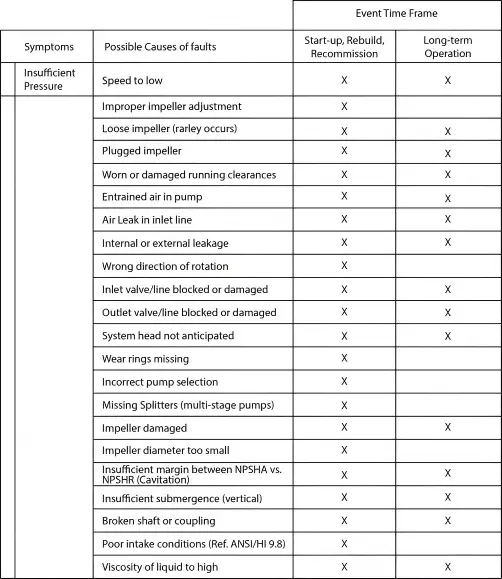
The following are some common pump start-up problems that may cause lower-than-expected pressure, but these are not all the cases (see Table 1 below for more considerations). Troubleshooting these issues requires understanding the interaction between the pump and the system, performing some basic measurements, and comparing the results to the pump’s performance curves.
You can refer to the troubleshooting section of ANSI/HI 14.4, “Rotary Power Pumps Installation, Operation and Maintenance Manual,” for relevant guidance. Additionally, it is recommended to consult the relevant sections of the ANSI/HII standards regarding pump piping (ANSI/HI 9.6.6), inlet design (ANSI/HI 9.8), and the effect of liquid viscosity on pump performance (ANSI/HI 9.6.7).